
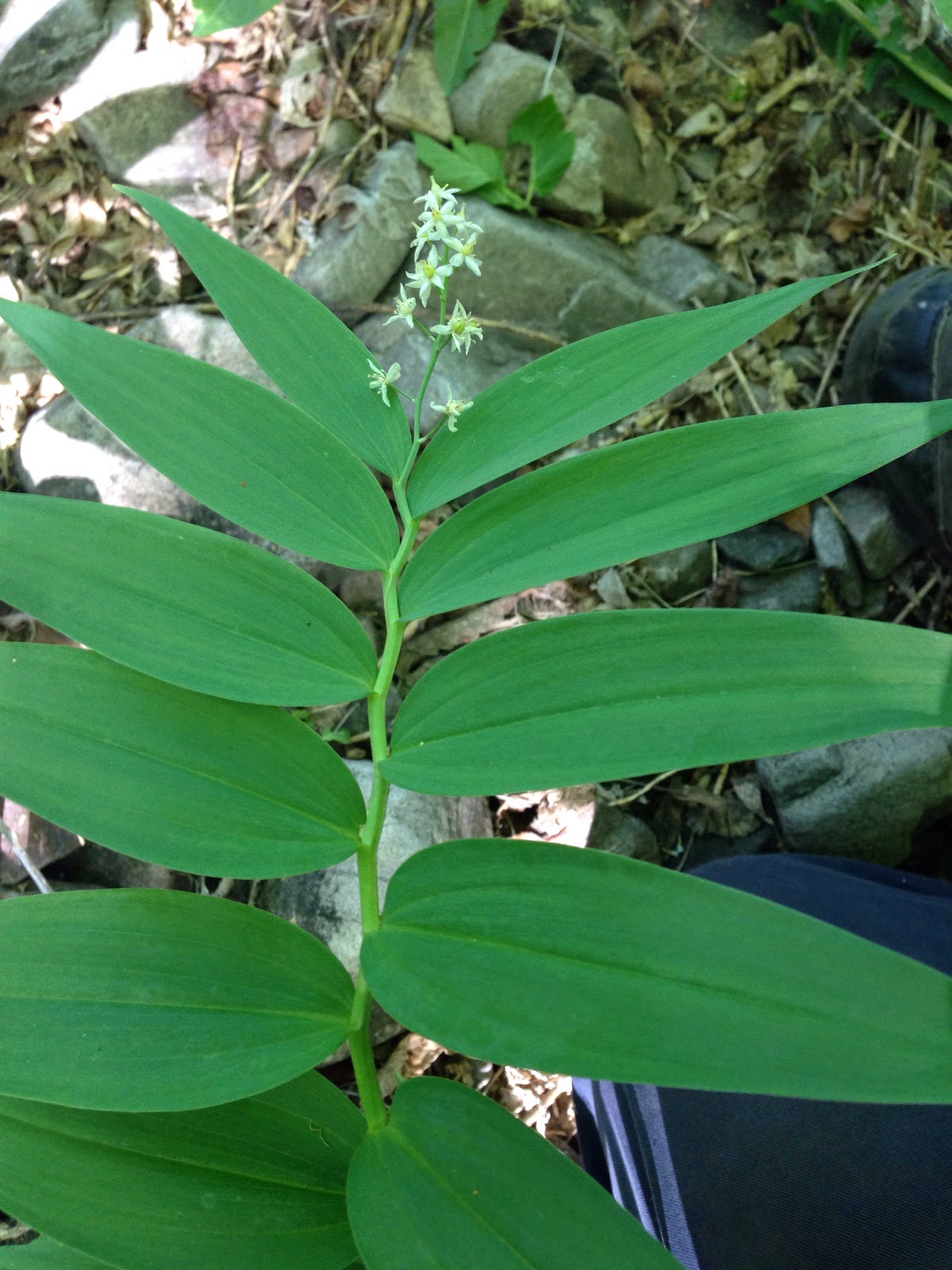
There are two kinds of False Solomon's Seal, Smilacina racemosa and Smilacina stellata. (Younger botanists have reclassified these plants as Maianthemum racemosum and Maianthemum stellatum, showing that you cannot always trust the latin name either.) Smilacina stellata, commonly known as Starry False Solomon's Seal, is far more common in my area. It is distinguished from the other species by being more slender in the size of its leaves, stem, and root. It also has fewer flowers in a simpler inflorescence. That is, there is a single flower or fruit on each branch coming off the main stem, whereas with Smilacina racemosa, each branch from the main stem branches again such that there are multiple flowers or fruit on each branch.
All parts of the plant are bitter, making this plant mostly one to avoid.
Samuel Thayer says (in Nature's Garden) that he quite likes the shoots of S. racemosum, but S. stellata has "very small shoots of poorer flavor". Even allowing for the poorer flavor, which was quite bitter, they are very tough and fibrous, and hard to get anything out of. Some of the very youngest ones were less tough when cooked, but not less bitter.
The rhizomes are easy to pull up if one finds them in soft soil. After boiling for 20-25 minutes to soften them, they become moderately edible, but still quite bitter. Not as bad as the shoots, but bad enough to be avoided unless starving, which is unlikely considering the number of much better tasting plants which grow in the same area.
In contrast to Smilacina stellata, its slightly larger cousin, Smilacina racemosa, is much better tasting and much less bitter. It is a very good edible plant, and you can read more about it in its own article.