
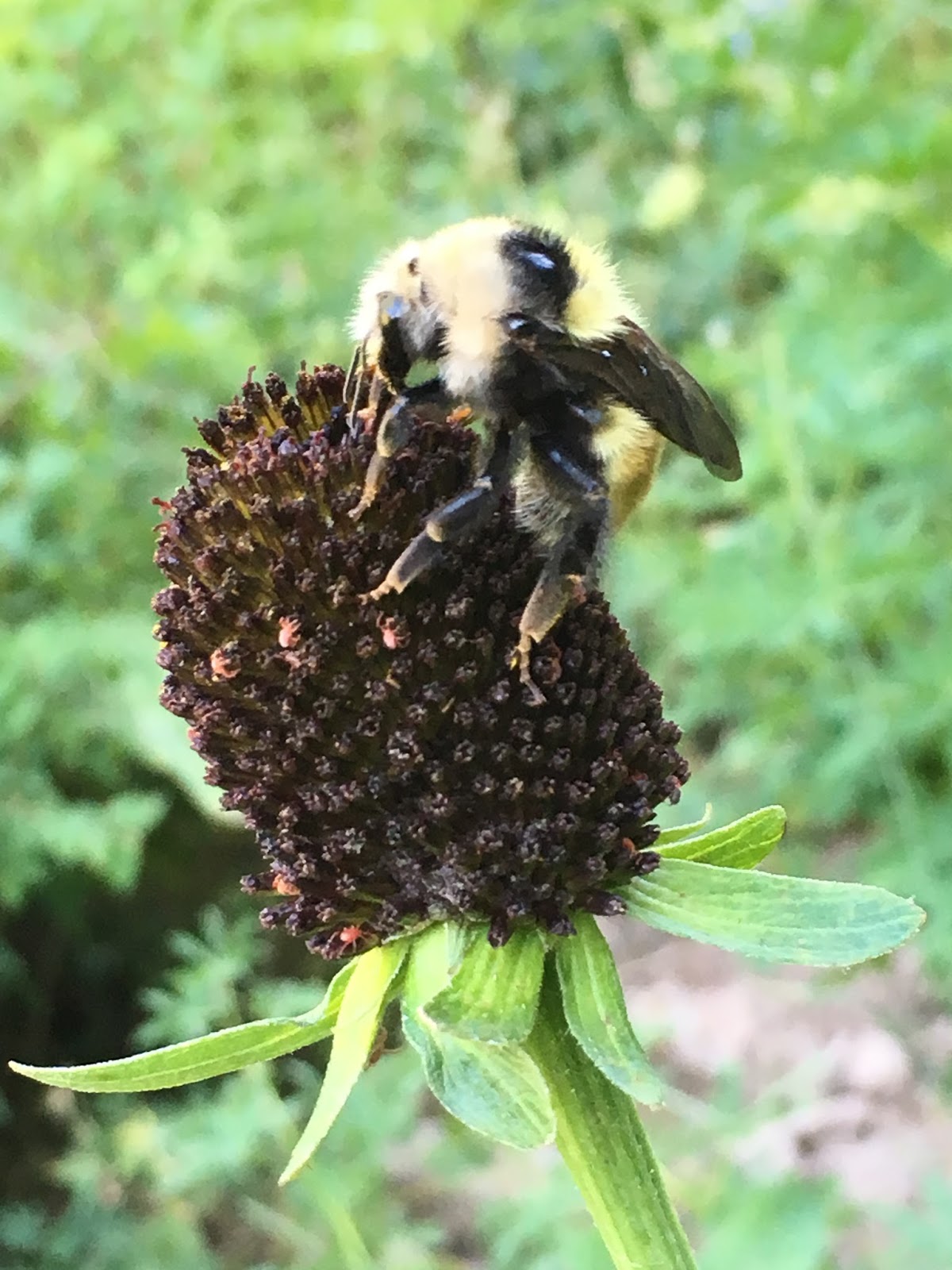
(with pollinator)
Western coneflower is the most common coneflower in the mountains where I live. Unlike most other coneflowers, it lacks the showy ray-flowers that other species have at the base of the cone, such as black-eyed susans or cut-leaf coneflower. This can make it hard to identify using a botanical key, because they don't put the Rudbeckia genus in the division of Compositae which has disk flowers only. On the other hand, once you recognize it as a coneflower, there isn't any other species it could be.
I enjoy eating these young coneflowers occasionally. One should eat the very young cones, about and inch or less tall. The larger flowers become pithy and tough inside. The young flowers are tender enough to eat, and have a vaguely minty flavor.
The leaves are very bitter; not recommended. They might be better in the spring, if one can learn to identify them when they are young.
A related species (Rudbeckia laciniata) is known as "Sochan" to the Cherokee Indians. They used the early spring leaves and shoots. There are reports of them being good tasting but they do not grow this far west.
Michael Moore [Medicinal Plants of the Mountain West, p. 93] describes good results with using Rudbeckia laciniata similar to how one uses Echinacea for colds and flus. His comments are intriguing. "Unlike Echinacea, lance-leafed Coneflower stimulates secretions, respiration, and the skin and kidneys, thereby helping to excrete the very waste products its immunostimulus help create." A closely related species like Rudbeckia occidentalis is likely to have similar effects. Moore uses the roots and sometimes the leaves for medicinal purposes.