
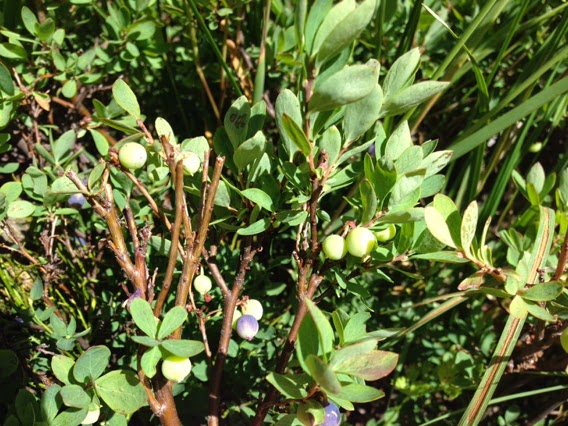
Vaccinium uliginosum var. occidentale has a close resemblance to huckleberries, and is known by a variety of common names, including "western blueberry", "western huckleberry", "bog bilberry", or even "bog whortleberry". Personally, I am currently preferring the "bilberry" name, even though that name is more commonly used for Vaccinium myrtillus. The "bilberry" name is used for any blue Vaccinium berry which is smaller than the common huckleberry, and this is the most common one which fits that description in my area. This is a low shrub which is commonly found at the edge of wet meadows, with marsh plants growing on one side of the shrub patch and dry plants growing on the other. Some meadows will have a border of these shrubs growing nearly all the way around them.
The branches are round and brown; the leaves are entire (i.e. not toothed) which distinguishes it from most other species in the genus; and the berries are blue and small (4-7 mm in diameter). The berries grow from the leaf axils, often singular, but are also found in clusters of 2-4. The flavor is not as good as real huckleberries, but still very good, both juicy and sweet. Collecting them can be rather hit-and-miss, because many bushes will have few or no fruit (perhaps having already been picked clean by wildlife), while occasionally a bush will be found with a lot of berries.