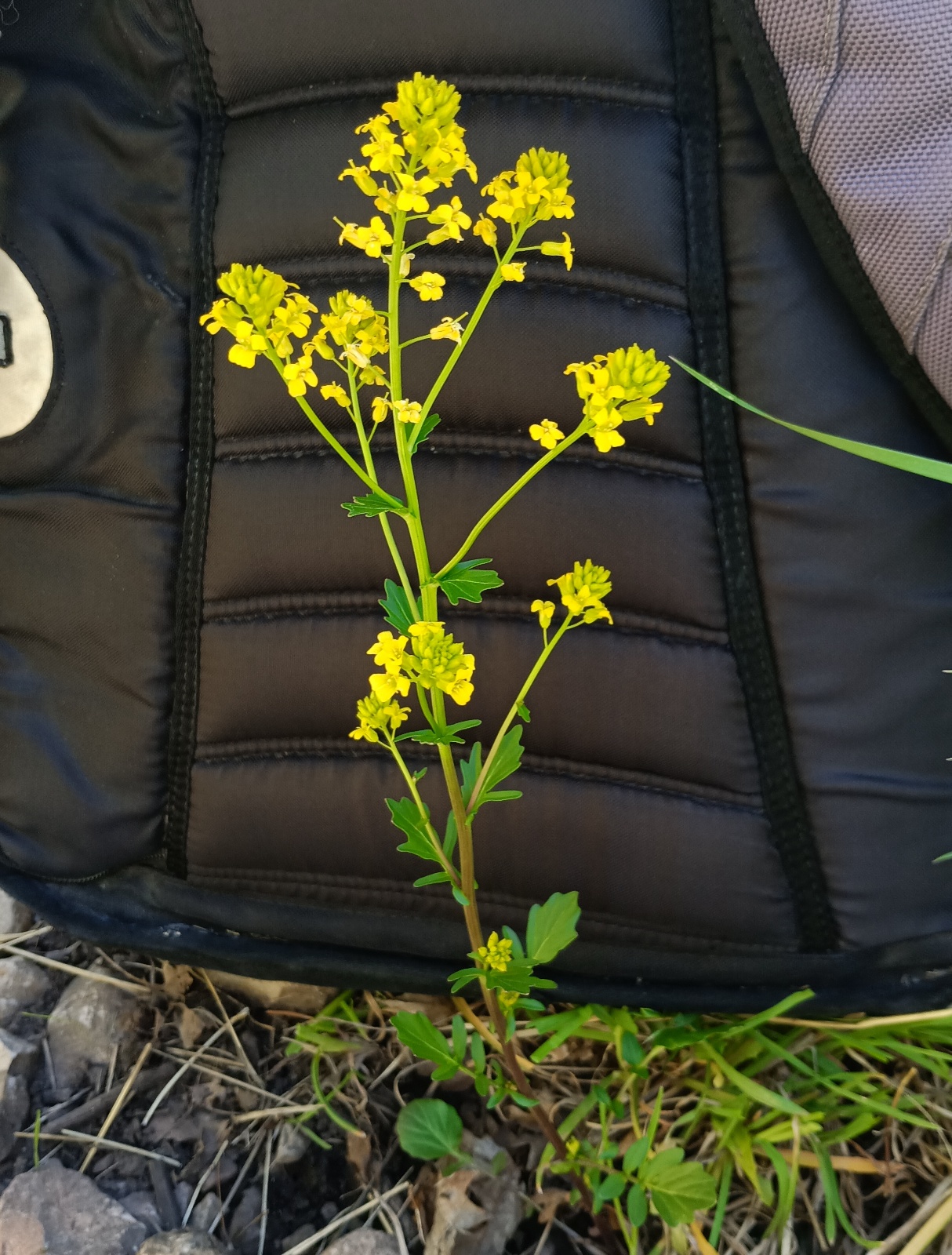
Barbarea vulgaris has a lot of common names, but the most common of the common names is Yellow Rocket or Wintercress. It is a member of the mustard family (Brassicaceae or Cruciferae), so it has yellow, four-petaled flowers less than a centimeter in width. (Each with 6 stamens, if you want to look very closely.) The leaves are smooth, slightly glossy, and thickish. They have a large lobe at the end, smaller lobes near the base, and usually a pair of lobes which clasp part way around the stem at the very base (auricles). Like many mustards, the leaves at the base of the plant are larger than the leaves near the flowers, but unlike most mustards, the stems and leaves are smooth, without any hairs.
When eaten raw, it has a strong, complex flavor. There are hints of spicy-mustard, and a pronounced bitterness, but the main flavor is something of a cross between broccoli and kale. There are many stories about it being a popular food in Italy, where they learn to tolerate and even appreciate the bitter flavor. It can be used in recipes as a substitute for Broccoli Rabe or Rapini (one of the cultivated forms of Brassica rapa). But it is too bitter for American tastes, and I definitely want to stop eating after a few leaves or flower clusters. I have used it in salads to give more variety of flavors, but I would not risk more than a small amount.
Fortunately, if you boil it for a few minutes, the bitterness is removed, and you have a much milder tasting vegetable. Two minutes of boiling is sufficient, followed by a cold water rinse to stop the cooking. The best part for eating is the clusters of unopened flower buds, which make a good broccoli substitute. The leaves are also good after boiling, but lose their substantialness and can be mushy if cooked too long.
I have used this in a stir fry as a substitute for broccoli. I boiled young flower bud clusters and leaves for a few minutes to remove the bitterness, and then added it to the stir fry at the very end, since it was already cooked. The flavor is not quite as good as broccoli, but it was definitely good enough for the stir fry.
I also tried frying it, and after reading other accounts that this cooking method did not remove the bitterness, I chose a strongly flavored oil (bacon grease). It is not too bad this way. The bitterness is still there, but it can work when cooked in bacon grease and combined with other vegetables. However the boiled flavor is much preferred.
Note that the stems of this plant are very tough and fibrous and quite difficult to break with out using a knife. Remove the leaves from the stem. And for the flower clusters, only use a small amount of stem. The tender top of the stem should break off easily with the flower cluster.
In spite of the common name Wintercress, I could find no sign of this growing in the winter, even during a mild Utah winter with relatively little snow. I went to the places I had seen it growing in the summer, and found no sign of it, at least until it started growing in the spring. Some plants will keep a basal rosette of leaves alive under the snow, in order to get a head start on growth when spring come. The name Wintercress made we wonder if this plant did that, but I did not find evidence of that.